
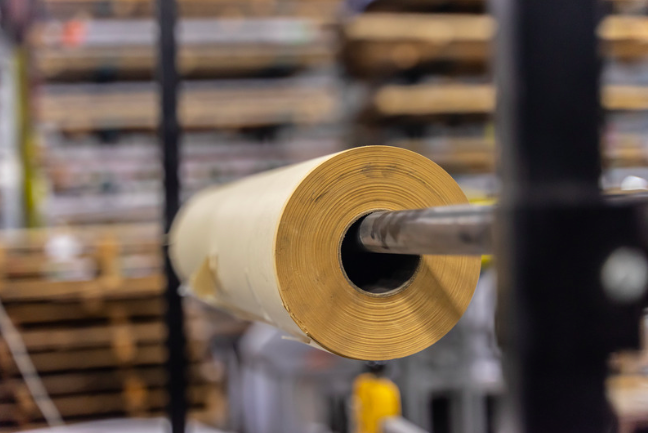
VCI paper represents a solution to protect metal components from corrosion during the critical phases of storage and transport. This eco-friendly paper is impregnated with a blend of volatile corrosion inhibitors, designed to ensure maximum protection for any type of metal.
During long periods of goods handling, there is an increasing risk of corrosion and rust formation. Metal corrosion is a chemical and electrochemical process that occurs due to the presence of a conductive solution, called an electrolyte, which typically forms in the presence of humidity, water, or condensation.
Common transport and storage conditions, using wooden crates or cardboard boxes, expose metal parts to climatic factors that promote corrosion. For this reason, it is essential to provide effective, suitable, and durable packaging.
In this article, we’ll explore the main applications of VCI paper, how it works, and the advantages of this anti-corrosion technology.
Main applications of VCI paper: when to choose it
The choice of VCI paper for packaging is essential in situations where anti-corrosion protection is of primary importance. VCI paper is the ideal solution to ensure the safety and integrity of materials when transporting or storing goods containing metal parts sensitive to corrosion.
Industries such as automotive, electronics, metalworking, marine, aerospace, defense/military, and many others—where metal components are crucial—benefit greatly from using VCI paper in their packaging. Its ability to maintain the quality and integrity of metal parts while reducing the risk of damage makes it a strategic choice for companies that want to protect their goods and ensure customer satisfaction.
How VCI works
The acronym VCI stands for Volatile Corrosion Inhibitor and works within closed packaging by evenly releasing particles into the atmosphere, creating a thin, invisible protective film that settles on the metal surfaces of the goods. This protective layer prevents the action of potential corrosive agents that could damage the metals.
When the packaging is opened, the VCI completely volatilize, leaving no residue on the metal surfaces.
The stages of VCI action are therefore:
- sublimation – the transition of VCI molecules from a solid to a gaseous state;
- diffusion – the volatile distribution of VCI molecules within the packaging;
- absorption – the deposition of VCI on metal surfaces.
The advantages of VCI paper
The advantages of using anti-corrosion VCI paper for packaging are numerous, making it an ideal solution for protecting metal components:
- Effective long-term anti-corrosion protection, thanks to the insulating barrier created by the VCI layer;
- Ease of use – simply place the anti-corrosion paper inside the package and wrap the metal parts;
- Replaces old oiling and greasing systems, which are polluting and less practical methods;
- Safe for materials – VCI paper contains no toxic or harmful substances and does not compromise the performance of packaged goods;
- Leaves no residue – once the packaging is opened, the goods are ready for immediate use without the need for cleaning.
To protect the metal parts of your goods, Flexpack offers not only VCI paper but also other anti-corrosion solutions: VCI polyethylene, VCI shrink wrap, VCI emitters and foams, VCI oil, and VCI bubble wrap.
Contact us today to find out how we can help you preserve the integrity of your products during transport and storage, and recommend the most suitable VCI anti-corrosion solution for your goods.
The article VCI Paper: the anti-corrosion paper to preserve metal components originally appeared on Flex Pack.







'/%3E%3Cpath%20fill='%23b2b2b2'%20d='M241%20382q0%2016%2017%2026%2017%2011%2042%2011t42-11q16-11%2017-26V269H241'/%3E%3Cpath%20fill='%239f7e00'%20d='M241%20379q0%2014%208%2023%209%209%2021%209%2014%200%2021-9%209-9%209-23V269h-59'/%3E%3Cpath%20d='M241%20339v-70h59v110q0%2014-9%2023l-6%205v-68h-15v72q-8%200-14-4v-68zm59%2040c0%2022%2015%2032%2029%2032%2021%200%2030-18%2030-32v-40h-59'/%3E%3Cpath%20fill='%239f7e00'%20d='M266%20277v5h2v12h-3v-5h2v-5h-9v5h2v5h-4v9h3v18h-5v10h34v-10h-5v-18h3v-9h-4v-5h2v-5h-9v5h2v5h-3v-12h2v-5zm42%20101q0%2010%206%2017%206%206%2015%207%2010-1%2016-7%206-7%206-17v-29h-43'/%3E%3Ccircle%20fill='%230044ad'%20cx='329.5'%20cy='372'%20r='6'/%3E%3Cellipse%20fill='%230044ad'%20cx='300'%20cy='340'%20rx='16'%20ry='21'/%3E%3C/svg%3E)