
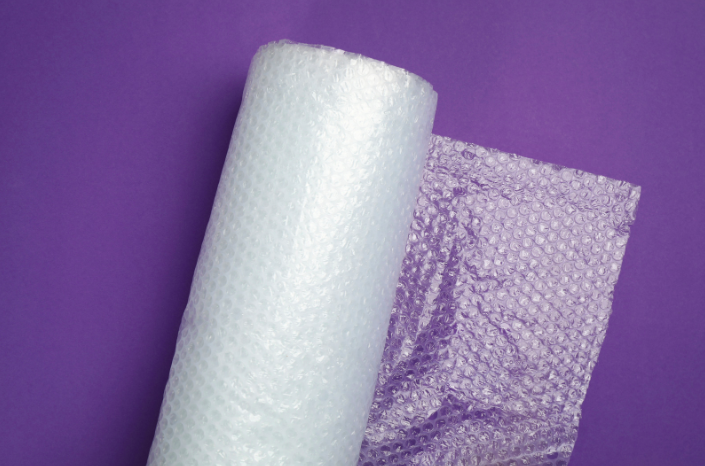
Invented in 1957 by engineers Alfred W. Fielding and Marc Chavannes, the bubble wrap packaging is one of the most widely used shipping materials, featuring unique characteristics that make it versatile and adaptable to different types of goods.
The discovery of this protective material was accidental: while attempting to design a special luxury wallpaper that could protect walls, make them washable, and provide a 3D texture, the two engineers joined two plastic shower curtains, creating trapped air bubbles. The wallpaper idea was unsuccessful, but they realized it could become an excellent insulating and packaging material.
Polyethylene bubble film, bubble wrap, or air bubble film
The bubble wrap packaging, also known as pluriball or polyethylene air bubble film, is made from a sheet of polyethylene — a synthetic, usually transparent polymer derived from a thermoplastic resin with insulating properties.
The air bubbles on the surface can vary in size and, in the event of mechanical impact, burst to absorb the shock, preventing the goods inside the package from being damaged.
Characteristics of bubble wrap
The main feature of bubble wrap is its ability to absorb shocks and vibrations, thanks to the air trapped inside the bubbles — keeping packaged goods safe and protected.
Other properties of bubble wrap include:
- Elasticity – flexible and able to adapt to the shape of the item, even for large or irregularly shaped objects;
- Transparency – allowing the contents of the package to be seen without opening it;
- Tensile strength – it does not easily tear or break under tension;
- Water resistance – suitable for protecting items from potential damage caused by rain;
- Lightness – it adds very little weight to the packaged goods;
- Ease of use – ideal for packaging both small individual products and large objects;
- Heat resistance – can withstand temperatures up to 80°C, or up to 95°C for short periods.
Finally, it is one of the most economical and widely available packaging materials on the market.
When to choose bubble wrap packaging
Bubble wrap packaging adapts to all packaging and protection needs as it can be produced in different weights and formats.
Bubble wrap can be used:
- As protective filling for packages containing fragile items, or to fill empty spaces between large goods while minimizing overall weight;
- To wrap and protect objects, even with irregular shapes, helping safeguard delicate components such as those in industrial machinery.
At Flexpack, we offer our customers different types of bubble wrap packaging: contact us for more information.






'/%3E%3Cpath%20fill='%23b2b2b2'%20d='M241%20382q0%2016%2017%2026%2017%2011%2042%2011t42-11q16-11%2017-26V269H241'/%3E%3Cpath%20fill='%239f7e00'%20d='M241%20379q0%2014%208%2023%209%209%2021%209%2014%200%2021-9%209-9%209-23V269h-59'/%3E%3Cpath%20d='M241%20339v-70h59v110q0%2014-9%2023l-6%205v-68h-15v72q-8%200-14-4v-68zm59%2040c0%2022%2015%2032%2029%2032%2021%200%2030-18%2030-32v-40h-59'/%3E%3Cpath%20fill='%239f7e00'%20d='M266%20277v5h2v12h-3v-5h2v-5h-9v5h2v5h-4v9h3v18h-5v10h34v-10h-5v-18h3v-9h-4v-5h2v-5h-9v5h2v5h-3v-12h2v-5zm42%20101q0%2010%206%2017%206%206%2015%207%2010-1%2016-7%206-7%206-17v-29h-43'/%3E%3Ccircle%20fill='%230044ad'%20cx='329.5'%20cy='372'%20r='6'/%3E%3Cellipse%20fill='%230044ad'%20cx='300'%20cy='340'%20rx='16'%20ry='21'/%3E%3C/svg%3E)